![[TITLE CARD HERE]](https://substackcdn.com/image/fetch/$s_!SUJW!,w_120,h_120,c_fill,f_webp,q_auto:good,fl_progressive:steep/https%3A%2F%2Fsubstack-post-media.s3.amazonaws.com%2Fpublic%2Fimages%2Fd0a7fd49-8c28-4108-8d36-8d3fa76673ad_1080x1080.png)
LIII. cotton candy
acting, babies, art, god...the usual

Four years ago, I booked contract after contract and thought I would never die. I was a Working Actor. Like my fellows I had an assortment of low-lift, part-time jobs, I didn’t pay rent as housing (dubious though some of it was) was provided, and I spent my per diems on rehearsal candy. I booked my first movie that year, my first play in New York. I got an accountant and an LA manager. And then the strikes. Then my manager’s nervous breakdown, our silent parting. Then auditioning for grad school, rejections. Then, in March of 2024, I signed with my first agent. As of around two months ago, about 109 auditions later, I booked my first commercial job1 in four years.
In this newsletter, I write about things outside of acting in-part because it’s odd to describe what being a “working actor” is when most of the time you are not on stage or in front of a camera. The work is constant but largely invisible to those on the outside. My comrades and I are rehearsing in apartments, running lines over FaceTime, sending cold-email drafts back and forth, reading, requesting discount codes, fretting over 3-line self-tapes, and perhaps finally performing for two magical nights to an audience of friends who are all doing the same. So much time and energy is dedicated to devising and creating and writing things and editing the things of others and all of this is the unseen pool we swim in, and as the years pass I realize that filling the pool is actually the work.
In March, I flew home to hold my best friend’s baby. The same best friend who got married last year, who has the beautiful home, who is forging a path so different, or maybe just sooner than my own. Her baby is perfect, by the way. His long toes and plump chin and swirl of tiny reddish brown hair. Katelyn is also perfect. The way she gazes at him and feeds him and smells his milk-breath like a junkie. When I visited it was March Madness; so to be in Kentucky meant half-slashed brackets covering every flat surface, games on in every room. I sat in the backyard bar Katelyn and Ryan built, watching a garage-mounted flatscreen, sipping a beer with a three-week-old baby on my chest.
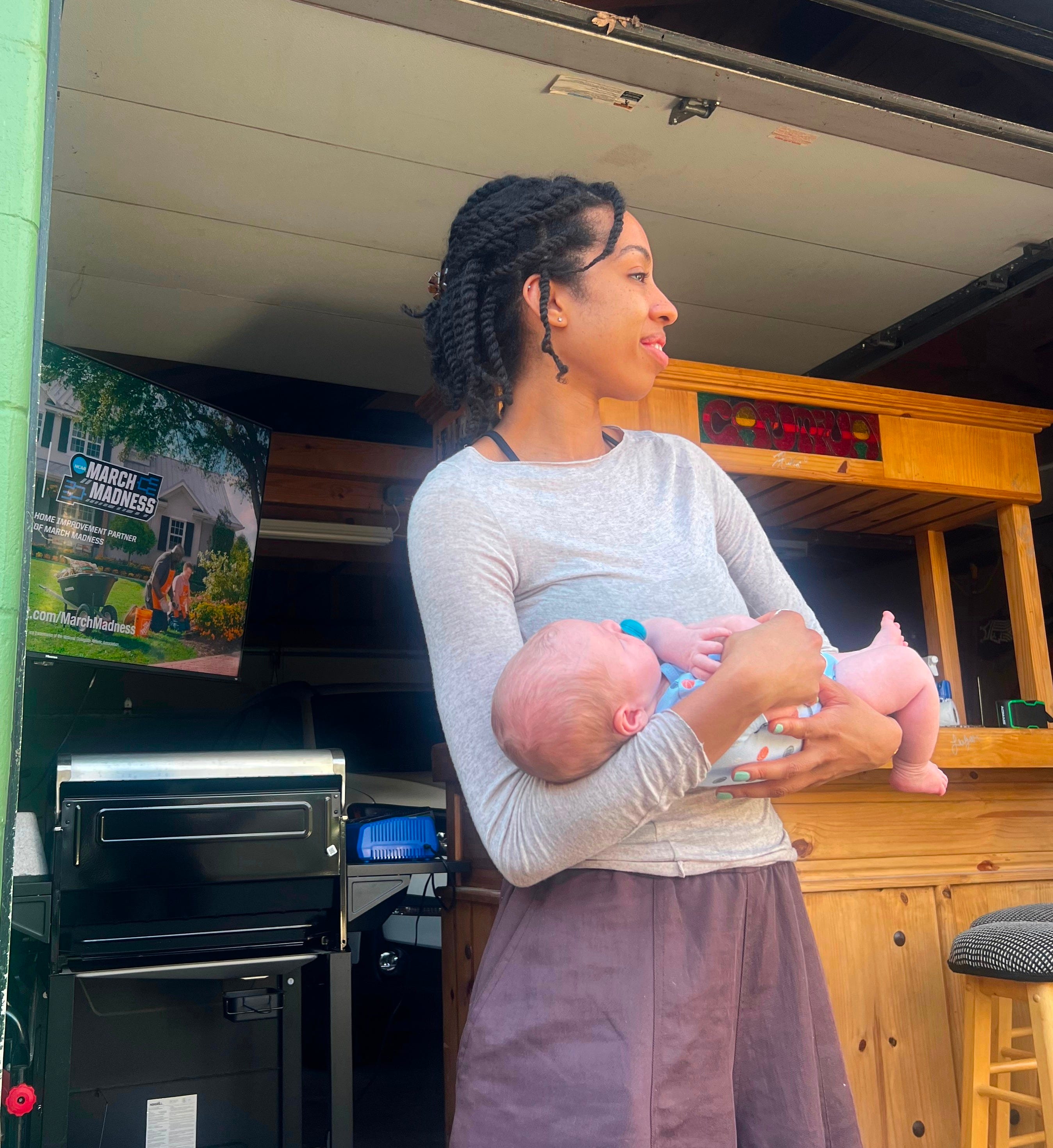
Every few days I am awed by the knowledge that a whole new person has arrived in this world, that a girl who had lime green zebra stripe walls brought him here. Katelyn swore he smiled on purpose for the first time the morning before I got there, which means by the time we met, he’d already had his first joy. Leaving Katelyn’s, I drove back to my grandparents’ in their cherry red two-door convertible. It was 85 degrees out and just before sunset. It was the first time I was home with a driver’s license and able to borrow the car—a sixteen-year-old’s milestone, out of time with my friend, but not so out of step.
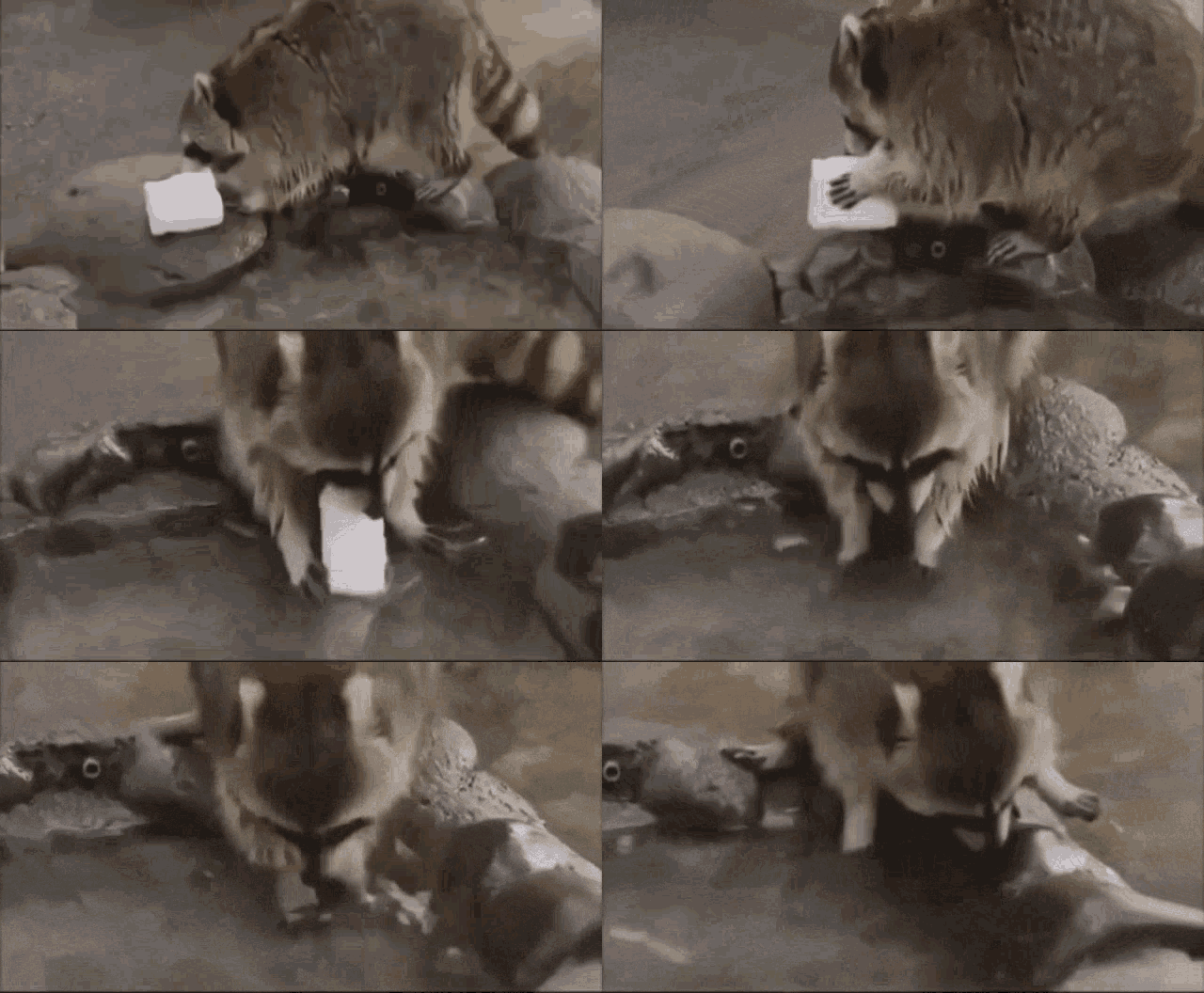
March also brought a beautiful wedding for my de-facto godmother, my first TV job, and an offer for a lead role in a play that I had to turn down because it conflicts with my brother’s wedding. In April Quentin and I went on a two-week vacation in Italy and then I started rehearsals while trying to retain my job. In the drafts I have written while cobbling together this essay, I see I am circling around gratitude without ever really getting a hold of it. I was clearly grateful—for the jobs, and my community, and the new blessings for the people I love most in the world—but I couldn’t seem to foreground it for longer than a moment. The most apt metaphor I could reach for was cotton candy. Everything felt sweet and overwhelming, gone in an instant with only trace evidence: a film on the teeth, sticky hands.
I do feel there must be a way to stop grabbing and grabbing towards the future. For the past month I have not had time to read anything other than As You Like It, but before that I was reading The Brothers Karamazov. The rumors are true, it is an excellent novel that everyone must read. There are so many incredible ideas packed into a very funny and swift-moving mystery (?) plot. It is completely unlike I thought it would be.2 I was prepared for some theological intrigue but I didn’t expect to feel so skewered by the 19th century social commentary. So much so that I have to reproduce a very long section of it below.
In order to make the world over anew, people themselves must turn onto a different path psychically. Until one has indeed become the brother of all, there will be no brotherhood. No science or self-interest will ever enable people to share their property and their rights among themselves without offense. Each will always think his share too small, and they will keep murmuring, they will envy and destroy one another. You ask when it will come true, but first the period of human isolation must conclude…which is now reigning everywhere, especially in our age, but it is not concluded yet, its term has not come. For everyone now strives most of all to separate his person, wishing to experience the fullness of life within himself, and yet what comes of all his efforts is not the fullness of life but full suicide, for instead of the fullness of self-definition, they fall into complete isolation. For all men in our age are separated into units, each seeks conclusion in his own hole, each withdraws from the others, hides himself, and hides what he has, and ends by pushing himself away from people and pushing people away from himself. He accumulates wealth in solitude, thinking: how strong, how secure I am now; and does not see, madman as he is, that the more he accumulates, the more he sinks into suicidal impotence. For he is accustomed to relying on himself, he has separated his unit from the whole, he has accustomed his soul to not believing in people’s help, in people or mankind, and now only trembles lest his money and his acquired privileges perish. Everywhere now the human mind has begun laughably not to understand that a man’s true security lies not in his own solitary effort, but in the general wholeness of humanity. But there must needs come a term to this horrible isolation, and everyone will at all at once realize how unnaturally they have separated themselves one from another. Such will be the spirit of the time, and they will be astonished that they sat in darkness for so long, and did not see the light.
This book was published as a serial between 1879 and 1880, proof perhaps that each person in their own time thinks their age is the worst. That said, I have the sinking feeling that we are the fulfillment of “horrible isolation;” that this “term” has stretched two centuries beyond what Dostoevsky could’ve imagined. Smarter people than I have written about the deleterious effects of AI dependence3, about the crashing world order, and our own demented cycling between crushing anxiety and even more crushing apathy. I will leave them to their good work, I must ramble about the art and the soul.
Our AYLI director (and I like to think fellow soul-rambler) Emma Rosa Went, spoke very beautifully in our first days of rehearsal about the kind of Arden she wanted to create—a place where everyone can exhale, drop their shoulders, play the kazoo, and stay awhile. In the play, we are plucked from the rigid control of the court and dropped into the woods which is, above all else, a place to hang out. I knew getting back in a rehearsal room would be fun but I was surprised at how moved I was—by this play, Mobile’s mission, these people, this Arden. I think every person in a creative field must reckon with the fundamental question: is art important? There are the bad answers: no = cynical/wrong; yes = naive/embarrassing/also wrong. There are the milquetoast answers: it is an important thing; it is for certain people in certain circumstance, etc. And there is the answer I am coming to today, no less embarrassing than yes by the way, which is that art as a verb, artmaking, is important, essential really if we are to stave off the separation, Dostoevsky’s “suicidal impotence.”
Making art is an attempt at connection. Bad, stupid, lazy or otherwise, you are reaching out a hand. It can still be, and often is, self-interested. “Each will always think his share too small, and they will keep murmuring, they will envy and destroy one another.” Artists are some of the most envious people I know, myself included. But to a point, I would argue that art’s dependence on the “other”—the reader, viewer, audience—combats this existential separation.
There is a difference, I think, between what one might be doing in their life and what one is doing when making their art. “For all men in our age are separated into units, each seeks conclusion in his own hole, each withdraws from the others, hides himself, and hides what he has, and ends by pushing himself away from people and pushing people away from himself.” A person, an artist, can certainly do this. They can stockpile resources and withdraw, pull the ladder up after they climb. But in their moments of creation—writing, painting, making a play—I think they cannot. I think you are not able to “seek conclusion in your own hole,” else why would you be making anything at all? Why try to make it in a certain way? Why express anything and why so particularly?
And God stepped out on space,
And he looked around and said:
“I’m lonely—
I’ll make me a world”
excerpt from The Creation by James Weldon Johnson
Art then, as evidence. For even one second someone wanted to know and be known, someone gasped up into the wholeness of humanity before they were sucked back down again. Which doesn’t mean what they made was good—aesthetically, morally or otherwise—but to me that impulse, the fact that we still have it, is important. And when that goes I do think we’re toast. I read that Brothers K passage and I think, he doesn’t even know how bad it’s going to get, how far we will fling ourselves into the oblivion of the individual. But then also I read that passage and I talk about it at every dinner party. I, like a street-corner evangelist, grab my friends by their lapels and shout the good news. We are not alone! Someone wrote to us.
More to say…always more to say, but for now.
xx
Mia
I have qualms and weirdness about this…the projects I have been part of from 2023-2026 were essential. They have given me an artistic community without which I certainly would have perished and I have been able to continue my work as an actor and writer and discover new hats—director, deviser, dramaturg, producer, general menace to the indie theater community. By commercial I merely mean those that materially aide in career longevity: money and platform.
Like many books I have come to actually know and love in my adulthood, I was first introduced to this one via the worst kind of boys at Yale. 06/05 edit: thank you Quentin for bringing it properly into my life.

I can’t get the raccoon/cotton candy out of my mind! Also must the Brothers K. Your writing (thought processes) blows me away!
:)